
Globalia Logistics Network Partners with TMS Transportation & Climate Change Conference 2026

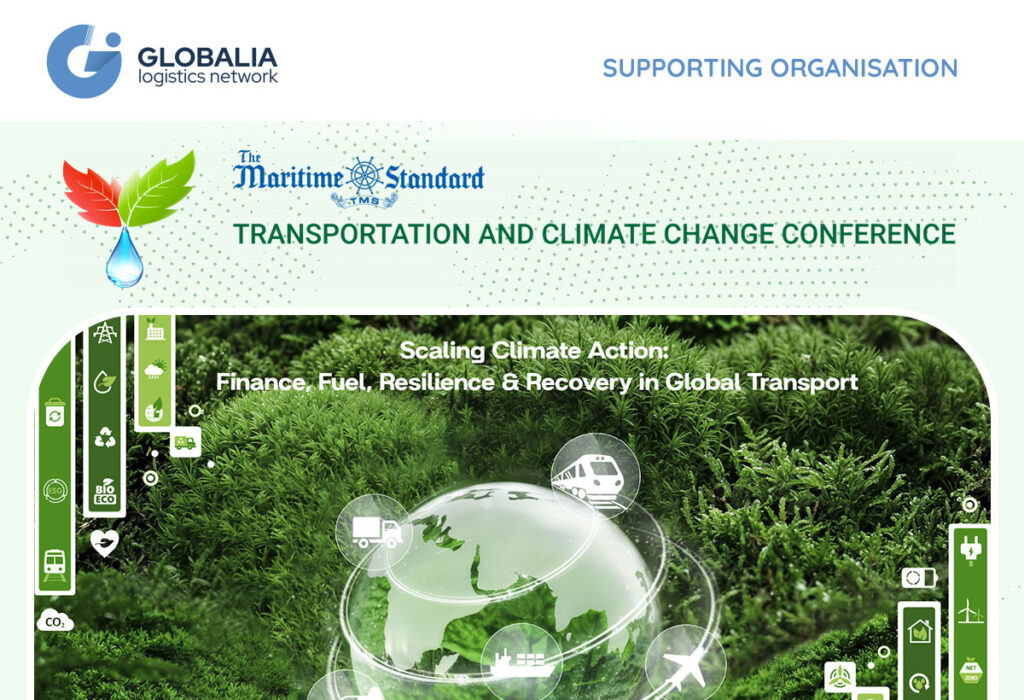
TMS Transportation & Climate Change Conference 2026 will be held on 24 September 2026 at Hilton Yas Island, Abu Dhabi, United Arab Emirates

Globalia Logistics Network is pleased to announce its partnership with The Maritime Standard Transportation & Climate Change Conference 2026, a global platform bringing together industry leaders, policymakers, and innovators to address the challenges and opportunities surrounding climate change and the future of sustainable transportation.

Under the theme Scaling Climate Action: Finance, Fuel, Resilience & Recovery in Global Transport, TMS TACCC 2026 will examine how finance, alternative fuels, infrastructure development, and digital transformation can accelerate the transition towards a more sustainable, secure, and resilient transport ecosystem.
The conference will bring together senior decision-makers from shipping, ports, logistics, energy, finance, technology, and government to discuss the practical challenges of delivering net-zero transport. Key discussions will address evolving regulations, carbon markets, alternative fuel pathways, financing models, energy security, and the resilience of global transport systems.

Key Industry Discussions

The 2026 programme has been developed against a rapidly changing global backdrop, with evolving regulatory frameworks, increasing carbon pricing pressures, alternative fuel development, geopolitical disruption and growing concerns around energy security and supply chain resilience influencing investment and strategic decision-making across the transport sector. The conference will examine how the industry can move from climate ambition towards real-world implementation by bringing together perspectives from across the maritime, transport, energy, infrastructure, finance and technology sectors.

The First Session

The first session, “Delivering Net-Zero Maritime: Regulation, Markets & Investment Readiness,” will focus on the regulatory, financial and commercial forces shaping maritime decarbonisation.

Discussions will examine the latest developments in the IMO’s global GHG regulatory framework, including the proposed fuel standard, GHG pricing mechanism, lifecycle emissions, chain of custody and compliance requirements. The session will also assess the implications of regional regulatory frameworks such as EU ETS and FuelEU Maritime, as well as the growing complexity created by overlapping international and regional climate policies.

Furthermore, this session will explore the implications of regulatory divergence for competitiveness, investment certainty and long-term industry strategy.  The financing of maritime decarbonisation will form another key area of discussion, with attention to green and transition finance, blended finance, insurance, public-private partnerships and multilateral support.

The programme will also take a practical look at alternative fuels, examining the availability, cost, infrastructure requirements, lifecycle emissions, safety and scalability of ammonia, methanol, LNG, hydrogen and biofuels. It will conclude by examining geopolitics, energy security and maritime resilience, exploring how disruption around critical maritime chokepoints is affecting energy flows, shipping routes, freight economics, insurance costs, emissions, infrastructure priorities and long-term investment strategies.

The Second Session

The second session, “Technology & Infrastructure: Scaling Decarbonized Transport Ecosystems,” will turn its focus towards the technologies, infrastructure and integrated systems required to move decarbonisation from pilot projects to large-scale implementation. The session will explore how advanced analytics, automation and digital tools can improve routing, reduce emissions and enhance operational performance across fleets and ports. Moreover, it will also examine the role of digital measurement, reporting and verification systems, blockchain and transparent carbon accounting in strengthening emissions tracking, compliance and accountability.

The transformation of ports will be another central theme, with discussions focusing on the development of Green Ports as integrated energy hubs equipped with shore power, alternative fuel bunkering, storage and grid connectivity.  As the availability of alternative fuels remains a key challenge for the transition, the programme will examine the requirements for industrial-scale fuel production and logistics, including global distribution networks, certification frameworks and cross-border collaboration to bridge the gap between supply and demand.

Attention will further turn to the decarbonisation of existing fleets through carbon capture, retrofitting technologies and energy efficiency measures, assessing their potential to reduce emissions from current assets while supporting a pragmatic transition. The programme will conclude with a focus on the wider ecosystem required to deliver the transition, highlighting the role of engineering companies, classification societies, shipyards, technology providers and logistics stakeholders in advancing innovation, compliance, vessel design and integrated system development.

Through its two core sessions, TMS TACCC 2026 will provide a platform for senior stakeholders to examine the intersection of regulation, finance, fuel, technology, infrastructure, energy security and resilience. The conference aims to support a practical and commercially focused dialogue on how the global transport sector can accelerate decarbonisation while responding to geopolitical uncertainty, evolving market conditions and the infrastructure demands of a rapidly changing energy landscape.

A Chance for Globalia Members to Connect with the Wider Sustainable Transport Community

For freight forwarders, TMS TACCC 2026 provides an opportunity to engage with the wider transport and maritime ecosystem and gain a deeper understanding of the regulatory, technological, and commercial developments influencing the future of global logistics.

Globalia encourages its members to participate in TMS TACCC 2026 as a valuable opportunity to expand their professional networks, gain insights into the latest developments in sustainable transportation, and connect with senior decision-makers from across the maritime, logistics, energy, and technology sectors.

 

More information & registration

Globalia Logistics Network Joins Transport Middle East 2026 as Supporting Organisation

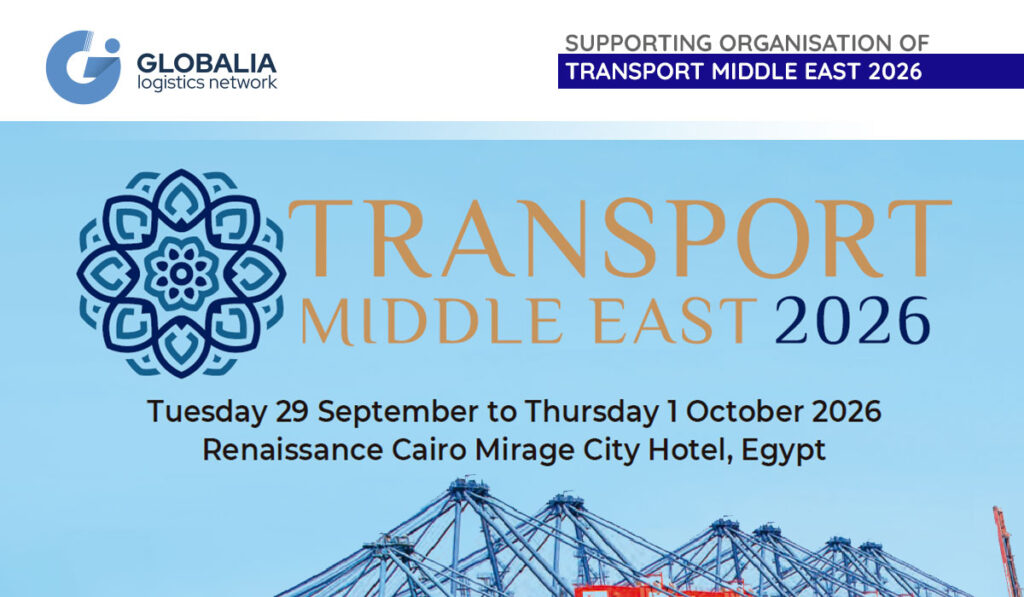
Transport Middle East 2026 will be held from 29 September – 1 October 2026 at the Renaissance Cairo Mirage City Hotel, Cairo, Egypt

Globalia Logistics Network is a Supporting Organisation of Transport Middle East 2026, one of the region’s major annual ports and logistics trade events. The 24th edition of Transport Middle East 2026 will bring together around 400 senior executives and industry professionals from ports, shipping lines, freight forwarding, logistics, terminal operations, cargo ownership, and related sectors from the Middle East, Africa, Europe, and connecting regions.

The two-day conference will feature 35 international speakers and focus on key issues shaping the future of transport and logistics, including the future of the Suez Canal, port development and infrastructure investment, intermodal connectivity, digital transformation, sustainability, maritime decarbonisation, and terminal efficiency.

The conference will also explore how Artificial Intelligence, Blockchain, Port Community Systems, and Cybersecurity are transforming supply chains and terminal operations, while dedicated sessions will examine green ports, alternative fuels, shore power, carbon reduction strategies, sustainable logistics solutions, containerisation, terminal efficiency, and equipment technology.

For freight forwarders, Transport Middle East 2026 provides an opportunity to engage directly with the wider maritime and transport ecosystem. With representatives from ports, shipping lines, terminal operators, cargo-owning companies, logistics providers, and infrastructure organisations expected to attend, the event offers an important platform for building relationships across the supply chain.

The event will also feature an international exhibition, giving exhibitors and sponsors the opportunity to connect directly with delegates and decision-makers throughout the conference.

Globalia encourages its members to consider participating in Transport Middle East 2026 as a valuable opportunity to expand their professional networks, gain insights into the latest developments affecting ports and logistics, and connect with industry leaders from across the Middle East, Africa, Europe, and other key trading regions.

More information & registration

As global supply chains continue to evolve, stronger connections between freight forwarders, ports, shipping lines, terminal operators, and logistics service providers are increasingly important. Through its support of Transport Middle East 2026, Globalia Logistics Network continues to strengthen its engagement with the wider transport and maritime community while creating additional opportunities for its members to connect with key industry stakeholders.


Interview with Globalia Warsaw and Gdynia


“We carry a green ambition: Sustainability means providing what is needed for our planet to continue to exist. We have to take responsibility for ourselves and each other, our business and society – and perhaps above all – the environment.”


Today we are publishing an interview with Ms Patrycja Musiał, Key Account Manager of Greencarrier Freight Services Poland. In this interview Ms. Musial talks about the need for sustainable logistics and how her company has been working towards the goal of a climate-neutral Europe by 2050.

Globalia Warsaw/Gdynia- independent freight forwarder
Patrycja Musiał, Key Account Manager of  Globalia Warsaw/Gdynia- independent freight forwarder

Q. What is the environmental impact of logistics?

A. The transportation sector is responsible for 14% of all energy-related CO2 emissions globally and this has more than doubled since the 70’s. In the EU the transportation sector generated 25% of all transportation CO2 emissions. Without actions and measures, this could increase faster than in any other sector. The message is clear from both European Union and elsewhere – we need to become more efficient and make a shift in technology to enable all of us to reach the goals of a climate-neutral Europe by 2050.

Q. Why should freight forwarding companies be thinking about creating more sustainable supply chain operations?

A. Scientific evidences are clear, mankind is affecting the climate, we all need to rethink how we plan our logistics. We can build solutions on various lead times and services based on green transport solution. We should focus on short sea, consolidation, rail, intermodal, biofuels, and direct flight. Sustainability is a high topic on the agenda in most industries today. The transport and logistics sector is no exception. It is everyone’s responsibility and opportunity to secure the future of business and society.

Q. Your name is Greencarrier. I guess that since your foundation, you have been worried about sustainability. How did you come up with this idea?

A. The Greencarrier Group was founded in 2000 by Stefan Björk and Björn Eklund. Right from the start, they had a clear vision of their future business – a freight forwarding company built on commitment, involvement, humour, and joy. And it turned out very much as planned. Our knowledgeable and skilled staff are the building block for today’s successful company, offering our customers sustainable logistics solutions served from the heart.

Q. What does sustainability mean for Greencarrier?

A. We carry a green ambition. Sustainability means providing what is needed for our planet to continue to exist. Freight forwarding companies have to take responsibility for ourselves and each other, our business and society – and perhaps above all – the environment.

Q. What is Greencarrier doing regarding sustainability?

A. The Greencarrier Spirit – this is our view on sustainability. The Greencarrier Spirit influences everything we do – every day – with the aim to take responsibility and act in a sustainable way in the long-term. At the very centre of the Greencarrier Spirit are our core values. They define who we are and what we stand for. What incorporates our spirit is how we do business, how we treat our employees, how we see ourselves as corporate citizens, and how we contribute to environmental protection.

Q. Which has been your most important shipment in sustainability?

A. One of the most important shipments we have arranged is the intermodal transport for Scandanavian fashion retailer Varner. We used a combination of road, sea and rail freight. We loaded the trailers with the products at Istanbul, from where it was taken to a nearby port. Next, we put the trailers on a ship and sent them to Trieste, Italy. There, the cargo was unloaded and moved to railway wagons and transported to Kiel, Germany. From there, we made use of ferry carriers to move the trailers to Gothenburg, Sweden. Lastly, from Gothenburg we used road transport to carry the cargo to its final destination in the Varner central warehouse. Members can check out the details of this sustainable transport on our blog.

Q. Which are your projects for 2021 on sustainability?

A. In 2021 we would like to reduce the total CO2 equivalent per TONKM by 15% compared to 2018 and in 2025 reduce the total CO2 equivalent per TOMKM by 30% compared to 2018.

Q. Which are the challenges of meeting the sustainability objectives for Greencarrier?

A. We strive to make sustainable choices easily accessible to our customers. Our Green Solutions are options where you can reduce a lot of CO2-emissions compared to the more traditional choices. We offer short sea, consolidation, rail, intermodal, biofuels, direct flight etc. The biggest challenge in these solutions is still the price and time. I would like to stress that many sustainable solutions are actually cost-saving.

Q.How has Greencarrier improved its transportation and logistics supply chain efficiency while taking care of the environment?

A. Greencarrier Freight Services provides transport solutions with all modes of transport all over the world. We take environmental actions which include developing our Green Solutions and using optimization of goods flow to reach higher load factors, shorter lead times, and lower CO2 emissions.

‘We strive to make sustainable choices easily accessible to our customers. Our Green Solutions are options where you can reduce a lot of CO2-emissions compared to the more traditional choices.”


Q. In your opinion, how freight forwarding companies can find a balance between financial growth, environmental care, and the health of society?

A. Our ambition is to provide the best service for each customer and at the same time be able to support and guide them through different options to optimize their supply chain- both from a financial and an environmental perspective. Green is lean, but you have to look at the whole supply chain in order to make the correct choices most suitable for your business. We have products and services developed to be more sustainable than traditional alternatives and these solutions are increasingly growing and changing the logistic world.

Q. Which mode of transport do you think is the most environment friendly?

A. We firmly believe that rail transport is the most effective and sustainable mode of moving freight across long distances. It is much more environment friendly when compared to air freight. We have recently launched a rail shuttle service between China, Europe and the UK. Companies importing goods from China need to consider switching to rail freight which is quick, sustainable as well as cost-effective. I invite members to read the interview on our blog where we have talked about the importance of using rail freight solutions for increased sustainability.

Q. What is the future of sustainability for freight forwarding companies?

A. To achieve sustainable transportation, we all have to:

– Optimize: Avoid unnecessary transportation, which includes increased load factors, using appropriate transport modes at each part of the supply chain and improve further logistics planning.

-Modal shifts: Transportation modes with greater environmental impact should be changed to more environmentally smart modes and new transportation combinations should be developed.

-Improve: We should improve and develop transportation technology through innovations such as more efficient fuels and modes of transport.

Globalia members with shipments to/from Warsaw/Gdynia, Poland, are invited to get in touch with their professional team.